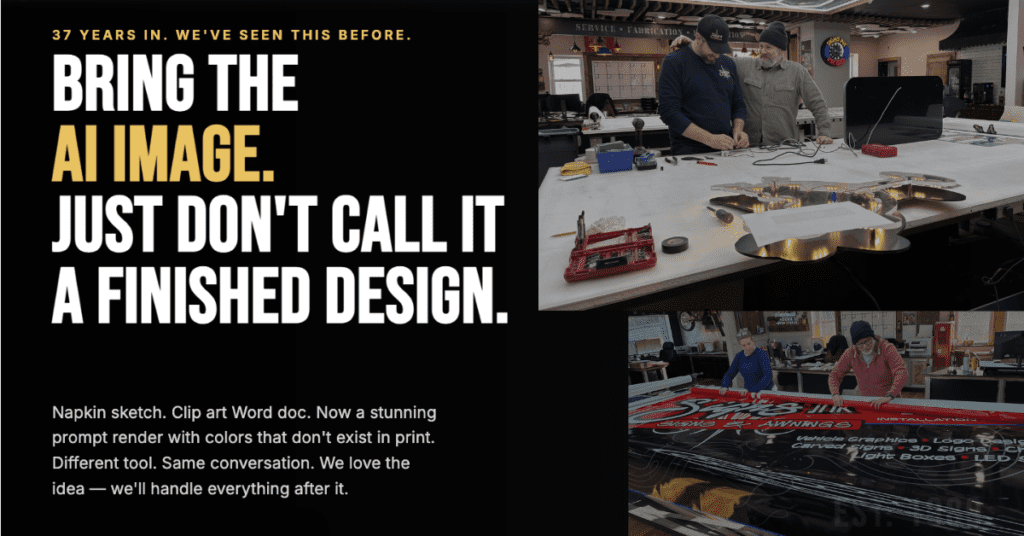
That AI image you’re excited about for your sign? Bring it. Just don’t call it a finished design.
We’ve gone from hand-painting layouts with a brush to printing full vehicle wraps in a single afternoon. We’ve seen every shift this industry has thrown at us. AI is just the latest one — and honestly, when used right, it might be the most useful yet.
Let’s get one thing out of the way: nothing — and we mean nothing — makes a designer’s eye twitch quite like a client walking in and saying “I already designed my sign in AI, you just have to produce it.”
We’ve heard versions of this sentence for 37 years. Different tools, same energy. Back in the day it was a napkin sketch. Then it was a Word document with clip art that had been stretched until it cried. Now it’s a stunning AI-generated image with colors that don’t exist in print, fonts that don’t exist in real life, and dimensions that don’t exist in this dimension.
Here’s the thing though — we’re not anti-AI. Not even a little. We use it ourselves. What we’re against is skipping the part where expertise actually matters. And in sign-making and vehicle wraps, that part is basically everything after the idea.
A real example from our shop
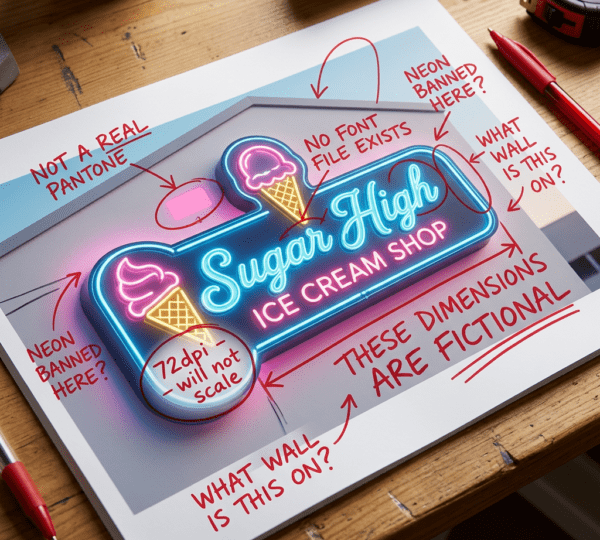
The neon ice cream sign — great idea, expensive reality check
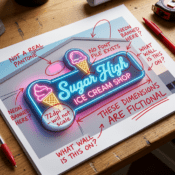
A client came to us with an AI-generated design for a new ice cream shop. And honestly? It was genuinely cool. A glowing neon ice cream cone logo, the shop name blazing in classic neon script — the kind of sign that would stop a kid mid-stride and drag every family within three blocks straight through the door. Great thinking. Exactly the right energy for a hip, fun ice cream joint.
Then we got to work on what it would actually take to make it happen.
What the AI didn’t know
- Real neon is extremely expensive to fabricate — and fragile
- Most municipalities have strict limits or outright bans on neon for exterior signage
- Getting a variance for neon? Possible — but slow, costly, and not guaranteed
- The dimensions in the AI image had no relationship to the actual building, the available wall space, or local size restrictions
- The design assumed a perfectly flat, perfectly proportioned surface that didn’t exist
What we did instead
- Kept the entire visual concept — the glow, the retro-cool energy, the personality
- Designed an LED “neon look” sign that nails the aesthetic at a fraction of the cost
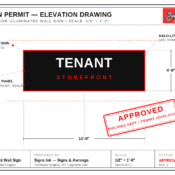
- Built it to actual permitted dimensions for their specific location
- Delivered something installable, code-compliant, and honestly? Better than the original concept
The AI image wasn’t wrong to exist. It was the perfect conversation starter. It just wasn’t — and couldn’t be — the finished product. That’s exactly how this should work.
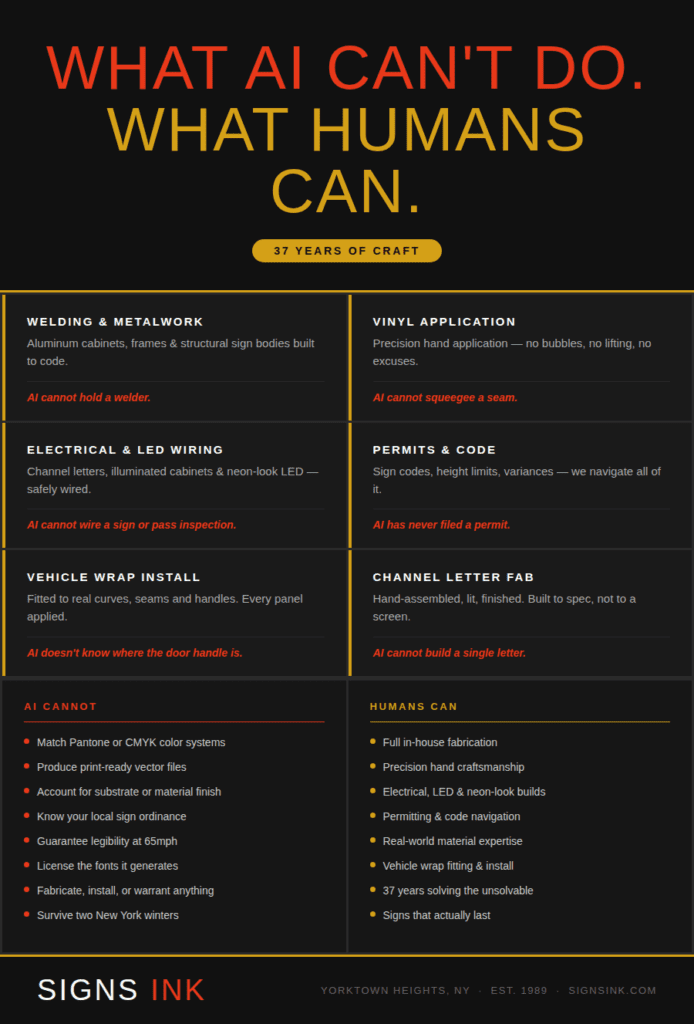
What AI genuinely cannot do (no matter how good the image looks)
- Match your exact brand colors in Pantone, CMYK, or spot color — AI generates pixels, not color systems. That “perfect red” is probably 47 slightly different reds.
- Produce print-ready, scalable vector artwork — Signs live at 4 feet, 40 feet, and 400 feet. A raster image generated at 72dpi will not survive that journey.
- Know your local sign code — Height restrictions, illumination rules, square footage limits, setback requirements, neon ordinances. AI has never once applied for a permit.
- Account for real-world materials and fabrication — What looks stunning on screen may be physically impossible, prohibitively expensive, or structurally unsound in the real world.
- Understand vehicle contours, seams, and curves — A wrap design that ignores the actual vehicle is a very expensive mistake. Door handles don’t just disappear.
- License the fonts it uses — That beautiful typeface in your AI image may not exist as a licensed font file. Or it does, and it’s $400.
- Guarantee readability at speed or distance — Legibility is a science. AI doesn’t know your sign will be read from a highway at 65mph.
- Account for real dimensions — AI images exist in a consequence-free spatial vacuum. Your building, your wall, and your sign code do not.
We’re not listing these to be difficult. We’re listing them because every single one has cost a client real time and real money when they assumed the hard part was already done.
“We’ve gone from hand-lettering a storefront to engineering a full fleet wrap in a week. The tools change. The craft doesn’t.”
How to share an AI concept so it actually helps
When a client brings a thoughtful AI image as a starting point, it genuinely changes the whole conversation — for the better. Here’s how to make it work:
Framing: inspiration, not artwork
Lead with “I love the feel of this” rather than “here’s the design.” One starts a creative conversation. The other starts a negotiation.
Annotation: Tell us what you actually love about it
The vibe? The color palette? The boldness? Specificity gets you there faster and skips three rounds of “warmer, more modern, less… that.”
Content: Pair it with real information
Business name, tagline, colors, size requirements, location. An AI concept without real content is just vibes. Vibes don’t go on a building permit.
Expectations: Don’t expect a 1:1 recreation
We’ll capture what drew you to it. We’ll also make it printable, permitted, legible, and structurally sound. That’s not ignoring your vision — that’s protecting it.
Trust: Let us push it further
37 years of signs in the real world — in weather, on vehicles, on buildings — is knowledge you can’t prompt your way to. Use it.
Volume: More images is better
Three or four AI concepts showing different elements you like gives us a real direction to work from. Give us a mood, not just a single image.
How we’re using AI on our end
- Rapid concept exploration in early client conversations — so you see options fast instead of waiting a week for a first draft
- Generating rough style and color directions before committing to full design rounds
- Showing clients visual options when words aren’t cutting it
- Speeding up the parts of our process that don’t require 37 years of experience — so those 37 years go where they actually matter
AI makes us faster at the front end. Our experience makes the result something you’d actually want on your building, truck, or storefront — and something your municipality will actually approve.
Bring us your AI image. Even the weird ones. Especially the weird ones.
We’ll tell you what’s possible, what isn’t, and what we can make even better.
Let’s build something →